
SS2 Chemistry
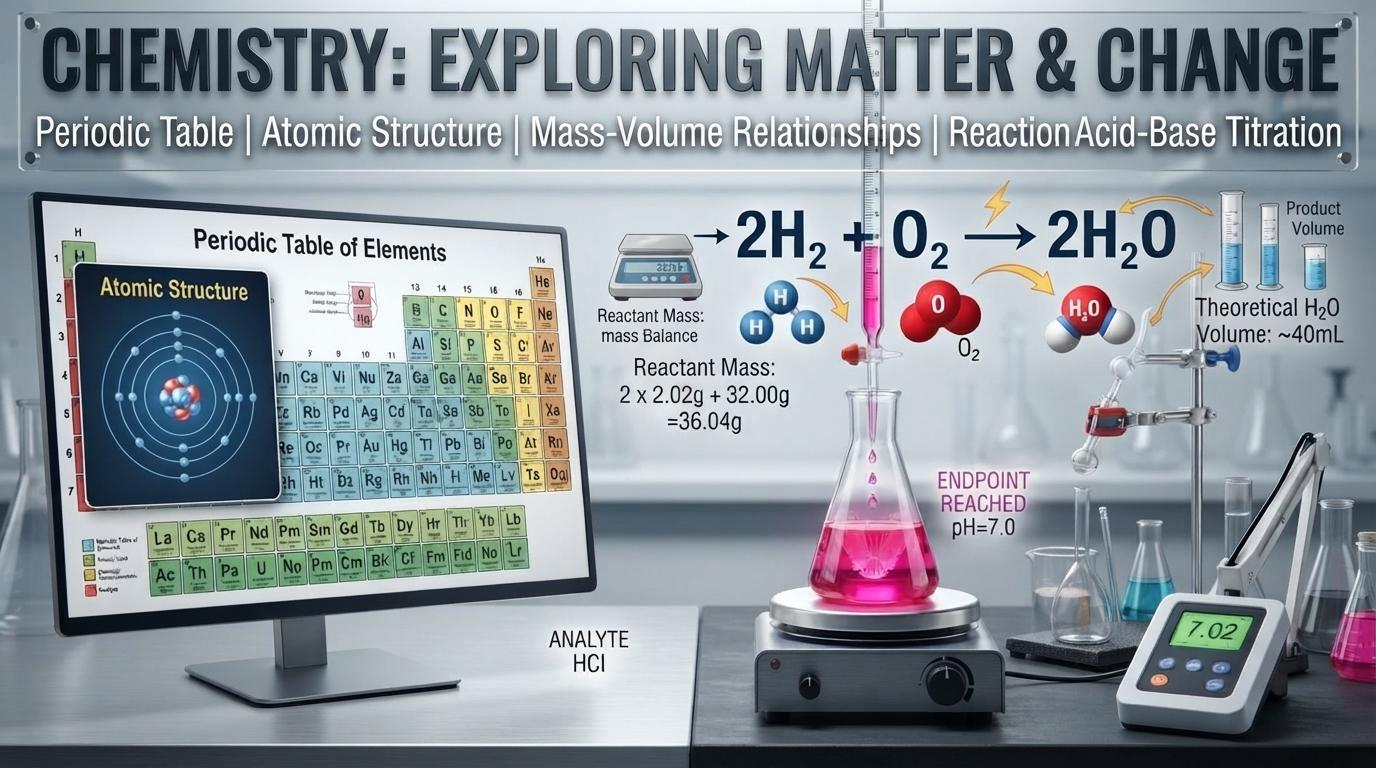
This SS2 Chemistry course provides students with a structured understanding of important concepts in physical, inorganic and analytical chemistry.
The course begins with the periodic table and periodic trends, helping students understand the arrangement of elements and how their positions relate to their physical and chemical properties.
Students will then study chemical reactions, including reaction rates, collision theory, factors affecting reaction rates, energy changes and thermodynamics. The course also introduces chemical equilibrium, Le Chatelier's principle, the Haber process, the law of mass action and equilibrium constants.
The course develops quantitative chemistry skills through the study of the mole, Avogadro's number, relative atomic and molecular masses, molar volume and stoichiometry. Students will learn to perform calculations involving mass, moles, gas volumes, particles, reactants and products.
The final section focuses on acid–base chemistry, including titration, standard solutions, indicators, titration procedures, experimental results and calculations for determining unknown concentrations.
Throughout the course, students are encouraged to connect theoretical concepts with chemical reactions, calculations and laboratory applications. By the end of the course, students should have a stronger understanding of fundamental chemical principles and improved skills in solving quantitative chemistry problems.
Meet Your Instructors

What you'll learn
- Explain the arrangement of elements in the periodic table and relate their positions to their properties.
- Describe and explain periodic trends in the physical and chemical properties of elements.
- Explain the rate of chemical reactions and apply collision theory to chemical reactions.
- Identify and explain the major factors affecting reaction rates, including concentration, temperature, surface area, pressure and catalysts.
- Explain energy changes in chemical reactions, including exothermic and endothermic reactions, enthalpy changes and activation energy.
- Explain chemical equilibrium, distinguish between static and dynamic equilibrium, and apply Le Chatelier's principle.
- Explain the mole concept, Avogadro's number, relative atomic mass, relative molecular mass and molar volume.
- Perform calculations involving moles, mass, gas volume and number of particles.
- Apply stoichiometric principles and balanced chemical equations to calculate quantities of reactants and products.
- Explain acid–base titration, standard solutions and the role of indicators.
- Carry out and interpret acid–base titration procedures and experimental results.
- Perform titration calculations to determine the concentration of unknown acids or bases.
What's Included
- A stronger understanding of fundamental SS2 Chemistry concepts.
- Improved ability to interpret and use the periodic table.
- Better understanding of chemical reactions and the factors that affect their rates.
- Improved understanding of energy changes and chemical equilibrium.
- Stronger numerical and quantitative problem-solving skills.
- Ability to solve mole, molar volume and stoichiometric calculations.
- Better understanding of acid–base reactions and titration.
- Practical knowledge of standard solutions, indicators and titration procedures.
- Improved ability to interpret experimental data and calculate unknown concentrations.
- Better preparation for Chemistry examinations and practical assessments.
- Greater ability to connect theoretical Chemistry with laboratory and real-world applications.