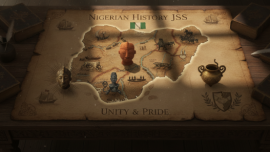
MAJOR NIGERIAN ETHNIC GROUPS AND THEIR ORIGINS
Subject: History | Class: JSS1 | Week: 4 | Duration: 40 minutes
Teacher: Mr Luqman Jibrin | Platform: Hamd House Academy Online (Klasio)
Theme: Linguistic Families
Nigeria has over 250 ethnic groups, each with its own language, food, dance, dress and traditions. This lesson shows students how historians and linguists organise this variety by language family. It also builds respect for the diversity of the country.
Visual anchor: the map Major Ethnic Groups of Nigeria (Hausa-Fulani in green, Yoruba in orange, Igbo in blue, other minorities in brown).
By the end of the lesson, students will be able to:
Define ethnic group and linguistic family clearly.
Identify the three major linguistic families in Nigeria.
Name Nigerian ethnic groups belonging to each family.
Locate the major groups on a map of Nigeria.
Nigeria is like a school with 250 uniforms: every group looks, sounds and celebrates differently.
Groups are classified by language family, like cousins who share grandparents.
Opening question: Can a Yoruba speaker understand Igbo? No, but both languages belong to the same large family, Niger-Congo. They are distant relatives whose languages share an ancient ancestor.
TermMeaningEthnic groupPeople who share a common language, culture, traditions and often ancestryLinguistic familyA group of related languages with a common origin and similar featuresLinguistA person who studies languages and classifies themDiversityVariety; Nigeria is highly diverseMigrationThe historical movement of peoples from one place to another
Ethnic group = shared language + culture + ancestry. The three largest are Hausa, Yoruba and Igbo.
Nigeria also has many smaller minority groups, such as Tiv, Edo, Ibibio, Ijaw and Kanuri. Minority means smaller in number, not less important.
Linguistic family = a family tree. One ancient parent language branches into related modern languages.
Linguists group related peoples by language, even when they live far apart.
FamilyMain groupsWhere foundNiger-Congo (largest)Yoruba, Igbo, Edo, Ibibio, Ijaw, Tiv, and the Fulani (Fulfulde language)Forest and savanna South, Middle Belt; Fulfulde spoken across the NorthAfro-AsiaticHausa (Chadic branch)Mainly northern NigeriaNilo-SaharanKanuri and related peoplesNorth-east, around Lake Chad
Distribution
Niger-Congo: covers most Nigerians. Yoruba live in the South-West, Igbo in the South-East and Tiv in the Middle Belt.
Afro-Asiatic: the Hausa dominate northern trade in cities such as Kano and Sokoto.
Nilo-Saharan: the Kanuri built the old Kanem-Bornu Empire around Lake Chad, in present-day Borno State.
Key message: one linguistic family can contain many ethnic groups. This is diversity within unity.
Appreciate diversity in food, language, dress and festivals.
Promote national unity through understanding and respect for each other's history.
Understand migration, for example why the Fulani moved across West Africa.
Respect one another regardless of background, and fight tribalism.
Build a sense of belonging through common heritage despite differences.
Our JSS1 class has Hausa, Yoruba, Igbo and Tiv students, so there is diversity in one room.
Pidgin English helps people communicate across language families.
Festivals: Durbar (Hausa, North), Osun Osogbo (Yoruba, South-West) and New Yam (Igbo, South-East).
Discussion: are all three festivals Niger-Congo? No. Durbar is Hausa (Afro-Asiatic), while Osun Osogbo and New Yam belong to Niger-Congo peoples.
NYSC posts graduates to other regions so that young Nigerians meet and learn from other cultures.
Nigeria is among the most ethnically diverse countries in the world.
Hausa is spoken by over 70 million people, including second-language speakers. It is the largest Chadic language.
Some small Nigerian groups have fewer than 1,000 speakers, so their languages are endangered.
The Tiv are the largest minority group in the Middle Belt (Niger-Congo family).
#QuestionModel answer1Define ethnic group in your own words.People who share a language, culture, traditions and often ancestry.2What is a linguistic family?A group of related languages with a common origin.3Name two ethnic groups in the Niger-Congo family.Any two of Yoruba, Igbo, Edo, Ibibio, Ijaw, Tiv.4Which family does Hausa belong to?Afro-Asiatic (Chadic branch).5How does studying ethnic groups promote national unity?It builds understanding and respect, reduces tribalism and creates a sense of belonging.
Sketch a landscape map of Nigeria and shade the approximate locations of the Hausa, Yoruba, Igbo, Kanuri and Fulani.
List 10 ethnic groups and their linguistic families in a table.
Write 5 ways to promote unity in a diverse JSS1 class like ours.
Week 5: Nok Culture. Students will study Nigeria's early Iron Age civilisation, its terracotta sculptures and early iron smelting in Kaduna State.
These points differ from the original slides and the write-up. I recommend fixing them before you present.
Fulani language. The original places "Hausa & Fulani" in Afro-Asiatic. Hausa is Afro-Asiatic, but Fulfulde (Fulani) is Niger-Congo (Atlantic branch). "Hausa-Fulani" describes a shared culture and history, not one language family.
Map colours. The map shows ethnic groups, not language families, so do not tie its colours to the three families.
Nok content. The write-up treats Nok as a major part of this lesson, but it belongs to Week 5. The Nok infographic was repeated on several slides, so replace it with the Nigeria map or a family-tree diagram.
Nok dates. The slides give 900 BCE–200 CE in one place and 1500 BC in another. Choose one range for Week 5 (many sources give roughly 1500 BCE–500 CE).
"Top 5" claim. I changed it to "among the most ethnically diverse" because the ranking is hard to verify.
Borno on the map. It is shaded Hausa-Fulani green, but the Kanuri are the main group there. Point this out to students.
Tiv greeting. Confirm "Mba?" with a Tiv speaker before using it.
Slide 9 photo. It shows community elders, not a JSS1 class, so caption it accordingly.
Typos on the Nok infographic. "archolological" should be "archaeological" and "coleled" should be "coiled".
Truncated write-up. The pasted summary stopped mid-sentence in the assignment. Section 13 is completed from the original slides.
No Comments Yet