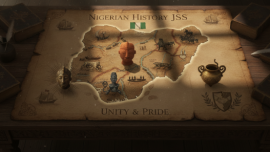
WEEK ONE : INTER GROUP RELATIONSHIP AMONG CENTRALIZED AND NONE CENTRALIZED STATES
For the class recording, please contact your course instructor.
For the class recording, please contact your course instructor.
Pre‑colonial Nigeria was made up of diverse groups before the 1914 amalgamation.
Some societies had centralized governments with kings, while others were non‑centralized, ruled by councils of elders or kinship groups.
Despite differences, these groups interacted through trade, marriage, culture, diplomacy, and conflict.
Definition: A centralized state is one with a single ruler (king/queen) who controls the government, army, and taxation system.
Analogy: Like a school with one principal making final decisions.
Key Features:
One supreme ruler (Oba, Alaafin, Sarki, Mai).
Clear hierarchy: King → Chiefs → People.
Organized army and taxation.
Large territories under control.
Examples:
Benin Kingdom – Oba, famous for bronze and ivory art.
Oyo Empire – Alaafin, strong cavalry, checked by Oyo Mesi council.
Hausa States – Sarki, fortified city walls, long‑distance trade.
Kanem‑Bornu – Mai, Sayfawa dynasty, trans‑Saharan trade, Islam.
Definition: Societies without a single ruler; power shared among elders, families, age‑grades, and title holders.
Analogy: Like a group project where everyone leads together.
Key Features:
No single king.
Decisions made by councils of elders.
Power distributed among families, age‑grades, and societies.
Smaller communities with shared governance.
Examples:
Igbo Society – Council of elders, Ozo title holders, age‑grades, Aro oracle.
Tiv – Kindred groups, lineage elders.
Ijaw – War canoe houses (family + army + trade).
Ibibio – Elders and Ekpo secret societies.
FeatureCentralized States (King)Non‑Centralized States (Council)RulerOne king (Oba, Alaafin, Sarki, Mai)No single king, council rulesPowerConcentrated in palaceShared among elders/familiesDecision‑makingQuick, top‑downSlow, consensus‑basedExamplesBenin, Oyo, Hausa, Kanem‑BornuIgbo, Tiv, Ijaw, Ibibio
Pre‑colonial Nigerian groups interacted in five major ways:
Trade – Exchange of goods (salt, leather, kola, palm oil, yams, bronze).
Inter‑Marriage – Built alliances and reduced conflict.
Cultural Exchange – Shared festivals, crafts, farming methods, languages.
Diplomacy – Peace treaties, messengers, tributes, elders’ councils.
Conflict – Competition for land, water, trade routes, cattle raids.
👉 Even after conflicts, relations continued—like family quarrels that never broke permanent ties.
| Date | |
| Duration | 80 Minutes |
| Meeting Link |
|
No Comments Yet